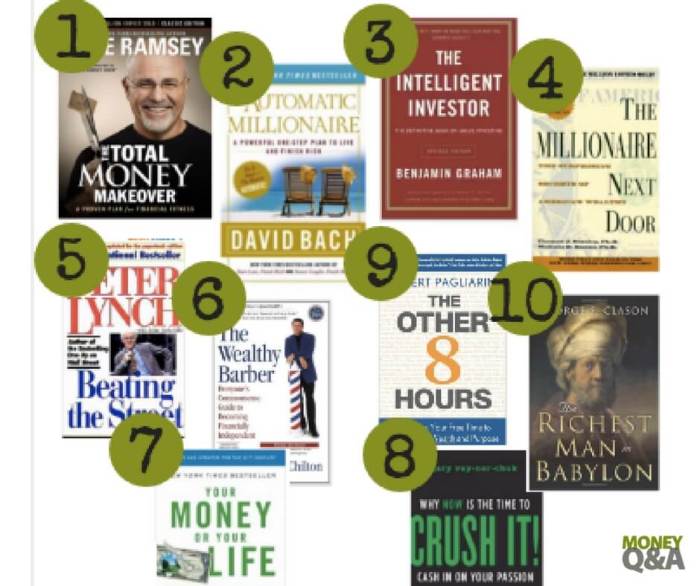
Navigating the world of personal finance can feel overwhelming, but the right resources can make all the difference. This guide explores the top personal finance books, examining their ranking methodologies, key concepts, and the lasting impact they’ve had on readers’ financial lives. We delve into various categories within personal finance, from investing and budgeting to debt management and retirement planning, providing a curated selection of titles to suit diverse needs and financial goals.
Whether you’re a seasoned investor or just starting to build your financial foundation, this exploration offers valuable insights and guidance.
We’ll analyze the criteria used to define “top” books, considering factors like sales figures, critical acclaim, and long-term influence. We’ll also compare and contrast the approaches different authors take, highlighting their unique perspectives and expertise. The goal is to equip you with the knowledge to select books that align with your specific financial journey and empower you to take control of your financial future.
Key Concepts in Top Personal Finance Books

Top personal finance books, while offering diverse approaches, consistently emphasize core principles to achieve financial well-being. These recurring themes provide a framework for readers to build a solid financial foundation, regardless of their specific circumstances or financial goals. Understanding these shared concepts allows individuals to synthesize information from multiple sources and develop a personalized financial plan.Many popular personal finance books present slightly different methodologies, yet share a common goal: empowering individuals to take control of their finances.
Some books emphasize strict budgeting and debt elimination as the primary path to financial freedom, while others advocate for a more holistic approach, incorporating elements of investing and wealth building alongside responsible spending habits. These contrasting approaches aren’t necessarily mutually exclusive; rather, they represent different starting points on the journey to financial security.
Budgeting and Debt Management
Effective budgeting is a cornerstone of nearly every successful personal finance strategy. Books frequently detail various budgeting methods, such as the 50/30/20 rule (allocating 50% of income to needs, 30% to wants, and 20% to savings and debt repayment), the zero-based budget (allocating every dollar to a specific category), and envelope budgeting (allocating cash to specific spending categories). Simultaneously, most books stress the importance of aggressive debt reduction strategies, often recommending the debt snowball or debt avalanche methods.
The debt snowball prioritizes paying off the smallest debts first for motivational purposes, while the debt avalanche focuses on paying off the highest-interest debts first to minimize overall interest payments. These methods are often illustrated with real-life examples of individuals successfully eliminating significant debt. For example, Dave Ramsey’s books often feature testimonials from people who used the debt snowball method to pay off tens of thousands of dollars in debt.
Investing and Wealth Building
Beyond budgeting and debt management, many books delve into the importance of investing for long-term financial security and wealth creation. These books often introduce basic investment concepts such as diversification (spreading investments across different asset classes to reduce risk), dollar-cost averaging (investing a fixed amount at regular intervals), and the power of compounding (earning returns on both the principal investment and accumulated interest).
Different books might emphasize specific investment strategies, such as index fund investing (investing in a diversified portfolio that tracks a specific market index), real estate investment, or individual stock picking. For instance, books promoting index fund investing often highlight the historical outperformance of low-cost index funds compared to actively managed funds.
Saving for Specific Goals
Many personal finance books dedicate sections to saving for specific financial goals, such as a down payment on a house, retirement, or children’s education. They typically Artikel strategies for determining how much to save, setting realistic timelines, and choosing appropriate savings vehicles (e.g., high-yield savings accounts, 529 plans for education). The books often provide practical examples and calculations to help readers determine their savings needs based on their individual circumstances and goals.
For instance, a book might illustrate how much one needs to save monthly to reach a $20,000 down payment goal within three years, considering a specific interest rate. Similarly, retirement planning sections often involve projections based on expected retirement expenses and anticipated investment returns.
Managing Student Loan Debt
The prevalence of student loan debt has led many personal finance books to dedicate significant portions to managing this specific financial challenge. These sections often discuss strategies for repayment, such as income-driven repayment plans, refinancing options, and consolidation strategies. They might also emphasize the importance of budgeting and lifestyle adjustments to free up additional funds for debt repayment.
For example, a book might explain the differences between various income-driven repayment plans and their impact on long-term repayment costs, providing clear examples of how each plan works.
Authoritative Voices in Personal Finance
The world of personal finance is vast and complex, encompassing saving, investing, budgeting, and debt management. Navigating this landscape effectively requires reliable guidance, and certain authors have consistently provided that through their insightful books and impactful contributions to the field. Their expertise, gleaned from years of experience and research, has shaped the way millions approach their financial well-being.
These authors offer unique perspectives, shaped by their backgrounds and approaches to financial literacy.The unique perspectives offered by leading personal finance authors are invaluable. Each brings a distinct blend of academic knowledge, practical experience, and personal philosophy to their writing, creating a diverse range of approaches to financial success. Understanding these diverse perspectives helps readers find the strategies and advice that best align with their individual circumstances and goals.
Prominent Personal Finance Authors and Their Contributions
Several authors consistently appear in lists of top personal finance books. Their works have influenced countless individuals and continue to shape the conversation around financial literacy. These authors have not only written best-selling books but have also significantly contributed to the broader understanding and application of personal finance principles.
- Dave Ramsey: Known for his aggressive debt-elimination strategies and emphasis on financial independence. Ramsey’s approach focuses on budgeting, eliminating debt, and building wealth through disciplined saving and investing. His straightforward, often emotionally charged, style resonates with many readers.
- Suze Orman: Orman’s work emphasizes empowerment and financial literacy for women. She provides practical advice on a wide range of topics, including investing, retirement planning, and managing debt, often with a focus on building confidence and control over one’s finances. Her accessible style and relatable stories make complex financial concepts easier to understand.
- Robert Kiyosaki: Kiyosaki is known for his “Rich Dad Poor Dad” series, which focuses on the importance of financial education and asset building. He advocates for financial literacy from a young age and emphasizes the distinction between assets and liabilities in building wealth. His work has been both praised and criticized, with some questioning the practicality of some of his strategies.
Biographical Sketches of Prominent Authors
The following provides brief biographical details on three influential authors, highlighting their unique contributions to the field of personal finance literature.
- Dave Ramsey: A radio host, author, and financial advisor, Ramsey built his empire on a message of financial responsibility and debt elimination. His “Financial Peace University” program and numerous books, including “The Total Money Makeover,” have helped millions of people take control of their finances. His emphasis on eliminating debt through a structured plan, coupled with his engaging personality, has made him a leading voice in the personal finance space.
Ramsey’s background in real estate and his personal journey out of debt contribute to the authenticity and relatability of his advice.
- Suze Orman: A self-made financial guru, Orman’s career began in the restaurant industry before she transitioned into the financial services sector. Her extensive knowledge, combined with her empathetic approach, makes her a trusted advisor for many. Orman’s books, such as “The 9 Steps to Financial Freedom,” offer practical strategies for managing money and building a secure financial future.
Her focus on empowering women to take control of their finances has made her a particularly influential figure. Her experience as a financial advisor directly informs her accessible and relatable advice.
- Robert Kiyosaki: Kiyosaki’s background is less traditional than many other personal finance authors. He is an entrepreneur and investor who emphasizes the importance of financial literacy and building assets. His best-selling book, “Rich Dad Poor Dad,” shares lessons learned from his own experiences and contrasts two contrasting approaches to financial management. While his advice has generated both praise and criticism, his emphasis on building assets and avoiding liabilities remains a core tenet of his teachings.
His unconventional background contributes to a unique perspective on wealth building.
Impact and Influence of Top Personal Finance Books
The enduring popularity and widespread impact of top personal finance books are undeniable. These books haven’t just sold millions of copies; they’ve demonstrably altered the financial trajectories of countless individuals, influenced cultural attitudes toward money management, and shaped the evolution of financial advice itself. Their influence extends beyond simple knowledge dissemination; they’ve fostered a global conversation about financial well-being and empowered readers to take control of their economic futures.The real-world impact of these books is evident in countless success stories.
For instance, readers of books like Dave Ramsey’s “The Total Money Makeover” have reported significant reductions in debt, increased savings, and improved overall financial security. Similarly, readers inspired by the principles Artikeld in “The Millionaire Fastlane” by MJ DeMarco have documented entrepreneurial successes and the creation of significant wealth through unconventional means. These are not isolated anecdotes; numerous online forums and testimonials showcase the transformative power of these books on readers’ lives.
The common thread is the empowerment these books provide, enabling individuals to make informed decisions and actively manage their finances rather than passively accepting financial hardship.
Real-World Examples of Positive Outcomes
Many individuals credit personal finance books with helping them escape the cycle of debt, achieve financial independence, or even build substantial wealth. For example, a single mother who diligently followed the budgeting strategies in a particular book was able to pay off her student loans and secure a stable financial future for her family. Another case study shows how a young professional, inspired by the principles of investing Artikeld in a different book, successfully built a diversified investment portfolio that generated substantial returns.
These are just a few examples among countless others that demonstrate the tangible positive impact of these books on people’s lives. The ability to manage personal finances effectively is often cited as a key factor in reducing stress and improving overall well-being.
Cultural Influence on Financial Literacy
Top personal finance books have played a significant role in raising financial literacy levels globally. Before the widespread availability of such books, financial knowledge was often confined to specialized circles or passed down through families. These books democratized access to crucial financial information, making it available to a much broader audience regardless of their background or socioeconomic status.
The simplification of complex financial concepts, coupled with practical advice and actionable strategies, made these books accessible and relatable to a wide readership. This increased accessibility has undeniably contributed to a broader cultural understanding of budgeting, investing, debt management, and other essential financial concepts. The popularity of podcasts and online communities dedicated to personal finance further demonstrates the ripple effect of these books in fostering a culture of financial awareness.
Evolution of Personal Finance Advice Across Decades
The content of top personal finance books reflects the evolution of financial landscapes and societal attitudes toward money. Earlier books, such as those published in the mid-20th century, often focused on conservative investment strategies and frugality. Later books, published during periods of economic boom and technological advancement, incorporated newer concepts such as index fund investing, real estate investing, and the potential of entrepreneurial ventures.
The rise of the internet and the proliferation of online trading platforms have also influenced the advice found in more recent books, leading to a greater emphasis on active investing and diversification. This evolution highlights the dynamic nature of personal finance and the adaptability of the advice offered in these influential publications. The shift in emphasis from simply saving to actively managing and growing wealth reflects broader societal changes and increased access to financial tools and resources.
Introduction to Personal Finance
Personal finance encompasses the management of one’s financial resources, encompassing income, expenses, savings, investments, and debt. Effective personal finance strategies are crucial for achieving financial security and overall well-being, allowing individuals to meet their current needs while planning for future goals. Understanding key concepts and adopting responsible financial habits is vital for navigating the complexities of modern financial life.Effective personal finance management requires a holistic approach, integrating various interconnected aspects.
Ignoring one area often negatively impacts others, highlighting the importance of a balanced and well-rounded strategy. Financial literacy, the ability to understand and apply personal finance principles, plays a pivotal role in this process, empowering individuals to make informed decisions and achieve their financial objectives. A lack of financial literacy can lead to poor financial choices, resulting in debt accumulation, financial instability, and reduced quality of life.
Budgeting
A budget is a detailed plan outlining anticipated income and expenses over a specific period. Creating a budget involves tracking income sources, categorizing expenses, and identifying areas for potential savings. Effective budgeting allows for better control over spending, helping individuals prioritize needs versus wants and allocate resources effectively towards savings and investment goals. Popular budgeting methods include the 50/30/20 rule (50% needs, 30% wants, 20% savings and debt repayment) and zero-based budgeting (allocating every dollar to a specific category).
Saving
Saving involves setting aside a portion of income regularly to build a financial safety net and achieve future goals. Savings provide a buffer against unexpected expenses, such as medical bills or car repairs, and are essential for achieving long-term financial objectives like buying a house or funding retirement. Different saving vehicles exist, including high-yield savings accounts, money market accounts, and certificates of deposit (CDs), each offering varying levels of liquidity and interest rates.
Investing
Investing involves allocating funds into assets with the expectation of generating returns over time. Investing offers the potential for higher returns compared to savings accounts, but also carries greater risk. Diversification, spreading investments across different asset classes (stocks, bonds, real estate), is crucial for mitigating risk. Understanding investment vehicles, such as stocks, bonds, mutual funds, and exchange-traded funds (ETFs), is essential for making informed investment decisions.
Debt Management
Debt management focuses on strategically handling outstanding debts to minimize interest payments and avoid financial distress. Strategies include creating a debt repayment plan, prioritizing high-interest debts, and exploring debt consolidation options. Understanding different types of debt, such as credit card debt, student loans, and mortgages, and their associated interest rates is crucial for effective debt management. High levels of debt can significantly impact an individual’s financial well-being and limit opportunities for savings and investments.
Retirement Planning
Retirement planning involves saving and investing systematically to ensure financial security during retirement. Strategies include contributing to employer-sponsored retirement plans, such as 401(k)s and pensions, and establishing individual retirement accounts (IRAs). Understanding retirement income sources, such as Social Security, pensions, and personal savings, is essential for creating a comprehensive retirement plan. Factors like retirement age, expected lifespan, and desired lifestyle significantly influence retirement planning needs.
Financial Literacy and Well-being
Financial literacy is the foundation of sound personal finance management. It empowers individuals to make informed decisions about budgeting, saving, investing, and debt management, leading to improved financial health and reduced stress. A financially literate individual understands the importance of saving for emergencies, investing for the future, and managing debt responsibly. This knowledge directly contributes to increased financial security, improved mental well-being, and greater overall life satisfaction.
Interconnectedness of Personal Finance Areas
A visual representation could be a circular diagram. At the center is “Financial Well-being.” Radiating outwards are five segments representing Budgeting, Saving, Investing, Debt Management, and Retirement Planning. Arrows connect each segment to the center and to each other, illustrating their interdependence. For instance, a well-managed budget (one segment) directly supports saving (another segment) and reduces the need for debt (a third segment), ultimately contributing to a secure retirement (a fourth segment) and overall financial well-being (the center).
Similarly, successful investing (a fifth segment) enhances savings and contributes to a more comfortable retirement. The interconnectedness visually emphasizes that neglecting one area negatively affects the others and overall financial health.
Ultimately, the best personal finance book for you depends on your individual circumstances and financial goals. This guide has provided a framework for evaluating and selecting books that resonate with your needs. By understanding the key concepts, diverse approaches, and the lasting impact of these influential works, you can confidently embark on your personal finance journey, armed with the knowledge and resources to build a secure and prosperous future.
Remember that consistent learning and application of these principles are crucial for achieving lasting financial well-being.
Essential FAQs
What is the best book for beginners?
There’s no single “best” book, but many beginner-friendly options focus on foundational concepts like budgeting and saving. Look for books with clear explanations and practical exercises.
How often should I update my financial plan based on these books?
Your financial plan should be reviewed and adjusted at least annually, or more frequently if there are significant life changes (marriage, job change, etc.).
Are these books suitable for all age groups?
While many books cover universal principles, some cater to specific age groups (e.g., retirement planning for older adults). Consider your stage of life when selecting a book.
Where can I find these books?
Most of these books are available at major online retailers like Amazon, and many libraries also carry them.


