
Mastering personal finance is crucial for building a secure financial future. This guide provides a comprehensive overview of essential financial management principles, from budgeting and debt management to investing and retirement planning. We’ll explore practical strategies and tools to help you take control of your finances and achieve your financial goals, regardless of your current financial situation. Understanding your financial health is the first step towards achieving long-term financial well-being.
Through clear explanations and actionable steps, this guide empowers you to navigate the complexities of personal finance with confidence. We cover a range of topics, offering diverse approaches to budgeting, debt reduction, and investment strategies. Whether you’re a beginner or seeking to refine existing practices, this guide offers valuable insights and practical tools to help you build a strong financial foundation.
Budgeting and Expense Tracking
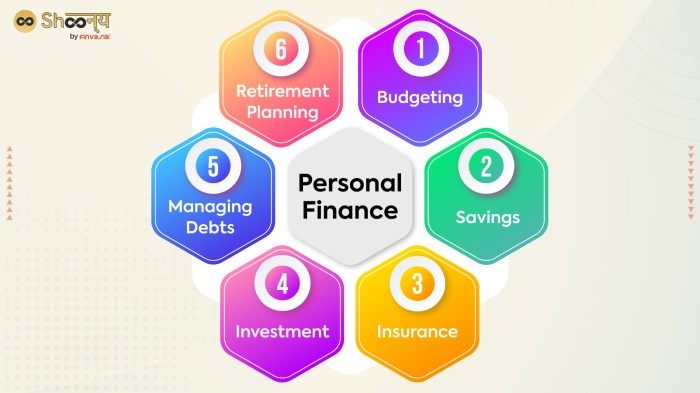
Effective budgeting and diligent expense tracking are fundamental to achieving your financial goals. Understanding where your money goes is the first step towards controlling your spending and building a secure financial future. This section will guide you through creating a budget and tracking your expenses effectively.
Sample Monthly Budget Template
A well-structured budget provides a clear overview of your income and expenses. This visual representation allows for easy identification of areas where adjustments can be made. The following table demonstrates a simple monthly budget template. You can easily adapt this to your own specific needs and income levels.
| Income | Expenses | Category | Notes |
|---|---|---|---|
| Salary: $4000 | Rent: $1200 | Housing | Includes utilities |
| Side Hustle: $500 | Groceries: $400 | Food | Weekly grocery shopping |
| Transportation: $300 | Transportation | Gas, public transport | |
| Dining Out: $200 | Food | Restaurants, cafes | |
| Loan Payment: $500 | Debt Repayment | Student loan | |
| Entertainment: $100 | Entertainment | Movies, concerts | |
| Savings: $500 | Savings | Emergency fund | |
| Total Income: $4500 | Total Expenses: $3200 | Remaining: $1300 |
Tracking Expenses Using a Spreadsheet
Utilizing a spreadsheet program (like Google Sheets or Microsoft Excel) provides a structured and efficient way to track expenses. Begin by creating columns for Date, Description, Category, and Amount. Categorizing expenses (e.g., Housing, Food, Transportation, Entertainment) allows for easy analysis and identification of spending patterns. Regularly inputting your expenses, ideally daily or weekly, ensures accuracy and prevents overlooking transactions.
At the end of the month, use spreadsheet functions (like SUMIF) to summarize expenses by category, giving you a clear picture of your spending habits.
Different Budgeting Methods
Several budgeting methods can help you manage your finances effectively. Two popular approaches are the 50/30/20 rule and zero-based budgeting.The 50/30/20 rule suggests allocating 50% of your after-tax income to needs (housing, food, transportation), 30% to wants (entertainment, dining out), and 20% to savings and debt repayment. This method offers a simple framework for prioritizing essential expenses.Zero-based budgeting involves assigning every dollar of your income to a specific category, ensuring all expenses are accounted for.
This meticulous approach helps identify areas for potential savings and fosters mindful spending. It requires more time and effort than the 50/30/20 rule but can be highly effective for those seeking precise financial control. For example, instead of a general “entertainment” category, you might allocate specific amounts for movies, concerts, and hobbies.
Debt Management
Effective debt management is crucial for achieving long-term financial stability. Understanding different debt types, strategizing repayment, and diligently tracking progress are key components of a successful approach. Ignoring debt can lead to escalating interest charges, damaged credit scores, and significant financial hardship. Proactive debt management, however, empowers you to regain control of your finances and build a brighter financial future.Debt management involves understanding and strategically addressing various types of debt to minimize their financial impact.
This includes developing a repayment plan, choosing the right strategy, and understanding the implications of each debt type on your overall financial health.
Debt Repayment Strategies
Two popular methods for tackling high-interest debt are the debt snowball and debt avalanche methods. The debt snowball method prioritizes paying off the smallest debt first, regardless of interest rate, to build momentum and motivation. The debt avalanche method, conversely, focuses on paying off the debt with the highest interest rate first to minimize the total interest paid over time.
Both methods require discipline and consistent payments. The choice between them often depends on individual preferences and psychological factors; some people find the quick wins of the snowball method more motivating, while others prioritize the long-term cost savings of the avalanche method.
Creating a Debt Repayment Plan
Creating a comprehensive debt repayment plan requires careful calculation and organization. First, list all your debts, including the creditor, balance, minimum payment, and interest rate. Next, calculate the total minimum payment required across all debts. This establishes a baseline for your monthly payments. Then, determine how much extra you can afford to allocate towards debt repayment each month.
This extra amount will be crucial in accelerating your debt payoff. Finally, choose your repayment strategy (snowball or avalanche) and allocate your extra payments accordingly. Regularly reviewing and adjusting your plan as your financial situation changes is essential for success. For example, if you receive a bonus or unexpected income, you can allocate this towards your debt to expedite the repayment process.
Implications of Different Debt Types
Different types of debt carry varying implications for your personal finances. Credit card debt typically has high interest rates and can quickly spiral out of control if not managed carefully. Personal loans usually have fixed interest rates and repayment terms, offering more predictability. Student loans often have lower interest rates than credit cards but can represent a substantial long-term financial commitment.
Understanding the specific terms and conditions of each debt type is crucial for effective management. For instance, a high interest credit card debt will accrue more interest over time than a low-interest student loan, impacting the total repayment amount significantly. A well-structured repayment plan, tailored to the specifics of each debt type, is essential for minimizing long-term financial burden.
Savings and Investing
Building a strong financial future requires a robust savings and investment strategy. This involves not only setting aside money for emergencies but also strategically investing to grow your wealth over the long term. Understanding different investment vehicles and their associated risks is crucial for making informed decisions.
Emergency Fund
An emergency fund acts as a financial safety net, providing a cushion against unexpected expenses like medical bills, job loss, or car repairs. The ideal amount is typically three to six months’ worth of living expenses. This allows you to cover essential costs without resorting to high-interest debt during unforeseen circumstances. Strategies for building an emergency fund effectively include automating regular transfers from your checking account to a dedicated savings account, setting realistic savings goals, and tracking your progress regularly.
Consider using high-yield savings accounts to maximize interest earned while maintaining easy access to your funds.
Investment Options for Beginners
Several investment options cater to beginners, each with varying levels of risk and potential returns. Index funds, for example, offer diversification by tracking a specific market index (like the S&P 500), providing exposure to a broad range of companies with relatively low management fees. Bonds, on the other hand, represent loans you make to governments or corporations, offering a fixed income stream with lower risk than stocks but generally lower returns.
Exchange-Traded Funds (ETFs) are similar to index funds but are traded on stock exchanges like individual stocks, offering flexibility and diversification.
Investment Vehicle Comparison
| Investment Vehicle | Pros | Cons |
|---|---|---|
| Index Funds | Diversification, low fees, relatively low risk | Returns tied to market performance, limited control over individual holdings |
| Bonds | Fixed income stream, lower risk than stocks | Lower returns than stocks, potential for interest rate risk |
| ETFs | Diversification, flexibility, low fees, traded on exchanges | Returns tied to market performance, potential for price fluctuations |
| High-Yield Savings Accounts | High interest rates, FDIC insured (up to $250,000 per depositor, per insured bank), easy access to funds | Interest rates can fluctuate, returns may not keep pace with inflation |
Financial Goals and Planning
Effective financial management isn’t just about tracking expenses and paying bills; it’s about strategically planning for your future. A well-defined financial plan ensures you’re working towards your aspirations, whether it’s a comfortable retirement, your children’s education, or that dream home. This section will guide you through the process of setting and achieving your long-term financial goals.Creating a comprehensive financial plan involves outlining your objectives, determining the resources needed to achieve them, and establishing a timeline for implementation.
This proactive approach allows you to make informed decisions about your money, maximizing your potential for success.
Long-Term Financial Plan Design
A robust long-term financial plan encompasses various key life goals. These often include retirement savings, funding education (for yourself or your children), and planning for significant purchases like a home or a car. Each goal requires a separate savings strategy, considering the timeline and the anticipated costs. For example, retirement planning necessitates a longer-term approach compared to saving for a down payment on a house.
The plan should account for inflation and potential unexpected expenses, allowing for adjustments along the way. Regular review and recalibration are essential to maintain its effectiveness.
The Importance of SMART Financial Goals
Setting SMART financial goals is crucial for success. SMART stands for Specific, Measurable, Achievable, Relevant, and Time-bound. A vague goal like “save more money” is ineffective. A SMART goal would be: “Save $10,000 for a down payment on a house within the next two years by contributing $417 per month to a high-yield savings account.” This clarity provides direction and allows for consistent progress tracking.
The “Achievable” aspect ensures the goal is realistic given your current financial situation, while “Relevant” confirms it aligns with your overall financial objectives. The “Time-bound” element provides a deadline, fostering a sense of urgency.
Calculating Retirement Needs and Developing a Retirement Savings Strategy
Determining your retirement needs involves estimating your desired lifestyle and anticipated expenses in retirement. Consider factors such as healthcare costs, housing, travel, and leisure activities. A common rule of thumb suggests needing 80% of your pre-retirement income to maintain a similar lifestyle, but this is a broad generalization and individual needs vary greatly. Many online calculators and financial advisors can help you estimate your retirement needs based on your individual circumstances.Once your retirement needs are estimated, you can develop a savings strategy.
This typically involves contributing regularly to retirement accounts such as 401(k)s, IRAs, or other pension plans. Consider your risk tolerance and investment timeline when choosing investment options. A longer timeline allows for greater risk-taking, potentially leading to higher returns. Diversification across different asset classes (stocks, bonds, real estate, etc.) is also crucial to mitigate risk. For example, a 30-year-old might allocate a larger portion of their retirement portfolio to stocks, while a 60-year-old might favor a more conservative approach with a higher allocation to bonds.
Regularly reviewing and adjusting your investment strategy based on your progress and changing circumstances is essential for long-term success. The power of compounding returns over time is significant, so starting early is highly beneficial.
Tax Planning and Management
Effective tax planning is crucial for maximizing your financial well-being. Understanding tax laws and employing smart strategies can significantly reduce your tax burden and leave more money in your pocket. This section will guide you through organizing your financial records, identifying potential deductions and credits, and navigating the tax filing process.
Organizing Financial Records for Tax Preparation
Meticulous record-keeping is the cornerstone of successful tax preparation. Gather all relevant documents throughout the year to streamline the process come tax season. This proactive approach minimizes stress and helps ensure accuracy. A well-organized system will save you time and potential penalties.
- Maintain a dedicated file for tax documents. This could be a physical folder or a digital folder on your computer. Clearly label each document with the relevant tax year.
- Keep receipts for all deductible expenses. This includes charitable donations, medical expenses, and business expenses (if applicable).
- Record all income sources. This includes W-2s, 1099s, and any other forms reflecting your earnings.
- Use accounting software or spreadsheets to track income and expenses. This provides a clear overview of your financial situation and facilitates the preparation of your tax return.
Common Tax Deductions and Credits Available to Individuals
Several deductions and credits can reduce your taxable income or the amount of tax you owe. Understanding these provisions is key to minimizing your tax liability. Remember to consult a tax professional for personalized advice, as eligibility criteria can vary.
- Standard Deduction: A flat amount you can subtract from your gross income. The amount varies based on your filing status and age.
- Itemized Deductions: Specific expenses you can deduct, such as medical expenses exceeding 7.5% of your adjusted gross income (AGI), state and local taxes (subject to limitations), and charitable contributions. You can only itemize if the total exceeds your standard deduction.
- Child Tax Credit: A credit for qualifying children. The amount depends on the child’s age and your income.
- Earned Income Tax Credit (EITC): A credit for low-to-moderate-income working individuals and families. The amount depends on your income and family size.
Filing Taxes and the Importance of Year-Round Tax Planning
Filing your taxes accurately and on time is vital to avoid penalties. Understanding the different filing methods and deadlines is essential. Proactive tax planning throughout the year can significantly benefit your financial health.
Tax filing can be done electronically or via mail. The IRS provides various resources and assistance to taxpayers. Meeting the deadline is crucial to avoid penalties and interest charges. Consider using tax preparation software or consulting a tax professional for assistance.
Year-round tax planning involves making strategic financial decisions throughout the year to minimize your tax liability. This includes adjusting your withholding, maximizing tax-advantaged accounts like 401(k)s and IRAs, and strategically timing major purchases or investments. For example, contributing to a Roth IRA allows for tax-free growth and withdrawals in retirement, while contributing to a traditional IRA reduces your current taxable income.
Retirement Planning
Securing a comfortable retirement requires careful planning and a proactive approach to saving and investing. This involves understanding various income streams, managing the impact of inflation, and choosing the right retirement accounts to maximize tax advantages. A well-structured retirement plan provides financial security and peace of mind during your later years.
Sample Retirement Plan Incorporating Different Income Sources
A comprehensive retirement plan should ideally incorporate multiple income sources to mitigate risk and ensure a steady stream of income. Consider this example: Let’s assume John, age 45, aims to retire at
65. His plan might include
Social Security benefits, projected at $2,000 per month based on his current earnings and contribution history; a pension from his employer, providing an additional $1,500 per month; and investment income from a diversified portfolio of stocks, bonds, and real estate, targeted to generate $3,000 per month. This combination of income streams provides a total projected monthly income of $6,500, offering a reasonable level of financial security in retirement.
It’s crucial to regularly review and adjust this plan based on market conditions, personal circumstances, and changes in benefit projections.
Inflation’s Impact on Retirement Savings and Mitigation Strategies
Inflation erodes the purchasing power of money over time. Savings intended for retirement twenty or thirty years from now will likely be worth significantly less in real terms. For instance, if inflation averages 3% annually, $100,000 today will have the purchasing power of approximately $55,000 in 20 years. To account for inflation, retirees should prioritize investments that aim to outpace inflation, such as stocks and real estate, which historically have provided returns exceeding inflation.
Regularly adjusting investment allocations and increasing savings contributions over time are also crucial strategies. Consider incorporating inflation-adjusted projections into your retirement plan calculations to ensure your savings maintain their purchasing power.
Types of Retirement Accounts and Their Tax Implications
Several retirement accounts offer tax advantages, influencing the overall financial outcome. 401(k) plans, offered by employers, allow pre-tax contributions, reducing taxable income in the present. However, withdrawals in retirement are taxed as ordinary income. Traditional IRAs also offer pre-tax contributions and tax-deferred growth, but withdrawals are taxed in retirement. Roth IRAs, in contrast, involve after-tax contributions but offer tax-free withdrawals in retirement, making them attractive for those who anticipate being in a higher tax bracket in retirement.
The choice between these accounts depends on individual circumstances, such as expected tax bracket, risk tolerance, and employer matching contributions. Understanding these tax implications is crucial for optimizing retirement savings and minimizing tax burdens.
Successfully managing personal finances requires consistent effort and a proactive approach. By implementing the strategies and techniques Artikeld in this guide, you can gain control of your financial situation, reduce stress, and work towards achieving your financial aspirations. Remember, consistent monitoring, adaptation, and seeking professional advice when needed are key to long-term financial success. Take charge of your financial future – start today.
Questions and Answers
What is the difference between the debt snowball and debt avalanche methods?
The debt snowball method prioritizes paying off the smallest debts first for motivation, while the debt avalanche method focuses on paying off the highest-interest debts first to save money on interest.
How much should I contribute to my retirement savings?
The ideal contribution depends on your income, age, and retirement goals. A general guideline is to aim for at least 15% of your pre-tax income.
What is a good credit score?
A good credit score generally falls within the 700-850 range, though the specific scoring models vary.
How often should I review my budget?
It’s recommended to review your budget at least monthly to track progress and make adjustments as needed.
What are some resources for improving financial literacy?
Numerous online resources, books, and financial literacy programs are available. Consider reputable sources like the Consumer Financial Protection Bureau (CFPB) and the National Foundation for Credit Counseling (NFCC).


