
Securing a comfortable and financially sound retirement requires careful planning and proactive management of personal finances. This guide delves into the essential aspects of retirement planning, from defining your goals and assessing your current financial standing to developing effective savings and investment strategies. We’ll explore diverse retirement vehicles, debt management techniques, and the crucial role of healthcare and estate planning in ensuring a secure future.
Understanding the time value of money, managing risk, and building an emergency fund are all integral components of this journey. We’ll provide practical steps and actionable advice to empower you to take control of your financial destiny and build a retirement plan that aligns with your aspirations and lifestyle preferences.
Retirement Savings Strategies
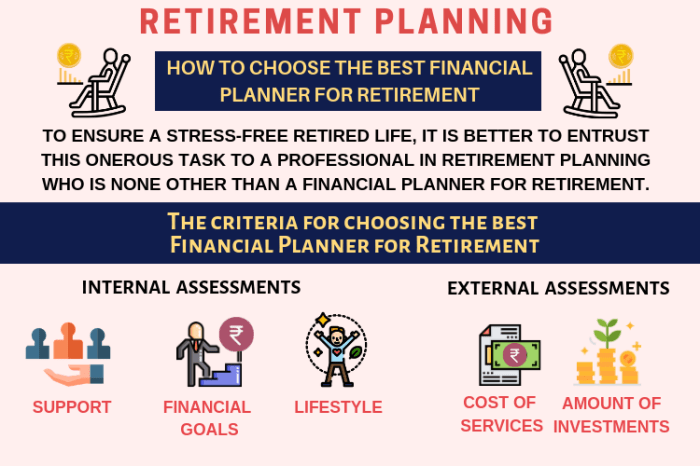
Planning for a comfortable retirement requires a thoughtful approach to saving and investing. Understanding the various retirement savings vehicles available and how they work is crucial for maximizing your long-term growth and achieving your financial goals. This section will explore different options, highlighting their benefits and drawbacks to help you make informed decisions.
Comparison of Retirement Savings Vehicles
Several key retirement savings vehicles offer distinct advantages and disadvantages. Choosing the right one depends on your individual circumstances, risk tolerance, and financial goals. These options generally fall into two categories: tax-deferred and tax-advantaged. Tax-deferred accounts postpone tax payments until retirement, while tax-advantaged accounts offer various tax benefits during the accumulation phase.
| Vehicle | Type | Contribution Limit (2023) | Advantages | Disadvantages |
|---|---|---|---|---|
| 401(k) | Tax-Deferred | $23,000 (plus $7,500 catch-up for those 50 and older) | Employer matching contributions, tax-deferred growth, potential for loan provisions. | Limited investment choices, early withdrawal penalties, potential employer restrictions. |
| Traditional IRA | Tax-Deferred | $6,500 (plus $1,000 catch-up for those 50 and older) | Tax-deductible contributions (depending on income and other factors), tax-deferred growth. | Income limitations for full deductibility, withdrawals are taxed in retirement. |
| Roth IRA | Tax-Advantaged | $6,500 (plus $1,000 catch-up for those 50 and older) | Tax-free withdrawals in retirement, potential for tax-free growth. | Income limitations for eligibility, contributions are not tax-deductible. |
The Power of Compound Interest
Compound interest is the cornerstone of long-term wealth building. It’s the interest earned not only on your principal but also on the accumulated interest from previous periods. This snowball effect significantly accelerates your savings growth over time.
The formula for compound interest is: A = P (1 + r/n)^(nt) where: A = the future value of the investment/loan, including interest; P = the principal investment amount (the initial deposit or loan amount); r = the annual interest rate (decimal); n = the number of times that interest is compounded per year; t = the number of years the money is invested or borrowed for.
For example, investing $5,000 annually for 30 years at a 7% annual return compounded annually would result in approximately $530,000, demonstrating the significant impact of consistent contributions and compounding. This contrasts sharply with a simple interest calculation, which would yield significantly less.
Opening a Retirement Account: A Step-by-Step Guide
Opening a retirement account is a straightforward process, though the specific steps may vary slightly depending on the chosen vehicle and financial institution.
- Choose a Retirement Account Type: Determine whether a 401(k), Traditional IRA, Roth IRA, or other plan best suits your needs and eligibility.
- Select a Financial Institution: Research and choose a reputable bank, brokerage firm, or financial advisor that offers the chosen account type.
- Gather Necessary Information: Collect your Social Security number, driver’s license, and other identifying information required for account creation.
- Complete the Application: Fill out the application form provided by the financial institution, providing accurate and complete information.
- Fund Your Account: Make your initial contribution to begin building your retirement savings. Regular contributions are key to maximizing the benefits of compound interest.
Managing Debt and Expenses
Planning for a comfortable retirement involves not only saving diligently but also strategically managing existing debts and anticipating future expenses. Failing to address these crucial aspects can significantly impact your financial security in retirement, potentially undermining years of careful saving. This section Artikels strategies to navigate these challenges effectively.
High-Interest Debt Reduction Strategies
Addressing high-interest debt before retirement is paramount. The high interest payments eat into your savings and reduce the funds available for your retirement. Prioritizing debt repayment frees up more of your income for retirement savings and reduces financial stress during retirement. Several methods can be employed to accelerate debt reduction. These include the debt avalanche method (prioritizing debts with the highest interest rates) and the debt snowball method (prioritizing debts with the smallest balances for motivational purposes).
Consolidating high-interest debts into a lower-interest loan can also significantly reduce the overall interest paid. Finally, exploring options like debt management plans with credit counseling agencies can provide structured support for managing and eliminating debt.
Inflation’s Impact on Retirement Expenses
Inflation steadily erodes the purchasing power of money. This means that the cost of goods and services will likely increase over time, impacting your retirement budget. For example, a retirement income sufficient today may not cover the same expenses in 10 or 20 years due to inflation. To mitigate this, retirees need to plan for inflation by estimating future expenses based on historical inflation rates and adjusting their savings goals accordingly.
Regularly reviewing and adjusting your retirement budget to account for inflation is crucial to maintain your desired living standard. Investing in assets that historically outpace inflation, such as stocks, can also help protect your retirement savings.
Budgeting and Expense Control in Retirement
Creating a realistic retirement budget is essential for ensuring financial stability. This involves carefully estimating your anticipated income from various sources, such as Social Security, pensions, and personal savings, and projecting your expenses, including housing, healthcare, food, transportation, and entertainment. Tracking your spending habits before retirement provides valuable insights into your expenditure patterns and helps you identify areas for potential savings.
Consider downsizing your home, exploring affordable healthcare options, and adopting cost-effective lifestyle choices to manage expenses efficiently in retirement. Regularly reviewing and adjusting your budget as circumstances change is crucial for maintaining financial control.
Visual Representation of Debt Reduction
A bar chart can effectively visualize a debt reduction strategy. The horizontal axis would represent the different debts (e.g., Credit Card A, Credit Card B, Personal Loan). The vertical axis would represent the debt balance in dollars. Initially, each debt would have a bar representing its starting balance. As payments are made, the length of each bar would decrease over time, reflecting the progress in debt reduction.
Different colors could be used for each debt type to enhance clarity. The chart would clearly illustrate the reduction of each debt over a specific period, allowing for easy monitoring of progress and providing a visual representation of the effectiveness of the chosen debt reduction strategy. For example, if Credit Card A initially had a balance of $5,000 and after six months the balance was $3,000, the bar for Credit Card A would show a significant reduction in length.
Personal Finance Fundamentals
Understanding the basics of personal finance is crucial for successful retirement planning. A solid grasp of core concepts like the time value of money, risk and return, and emergency fund creation significantly improves your ability to build a secure financial future. This section will cover these essential elements.
The Time Value of Money
The time value of money (TVM) is the concept that money available at the present time is worth more than the identical sum in the future due to its potential earning capacity. This is because money can earn interest or returns over time. For example, $100 invested today at a 5% annual interest rate will be worth $105 in one year.
The longer the money is invested, the greater the potential for growth. In retirement planning, understanding TVM highlights the importance of starting to save early. The earlier you begin investing, the more time your money has to grow, allowing for potentially larger returns by the time you retire. A simple formula illustrating this is: Future Value = Present Value x (1 + interest rate)^number of years.
This emphasizes the power of compounding, where earnings generate further earnings.
Risk and Return in Investing
Investing always involves a trade-off between risk and potential return. Higher-risk investments, such as stocks, offer the potential for greater returns but also carry a greater chance of losing money. Lower-risk investments, such as bonds or savings accounts, generally offer lower returns but are considered safer. Diversification, spreading investments across different asset classes, is a key strategy to manage risk.
For example, a portfolio might include a mix of stocks, bonds, and real estate to balance potential high returns with lower-risk investments, thereby reducing the overall portfolio risk. Understanding your own risk tolerance – your comfort level with the possibility of investment losses – is critical in choosing an appropriate investment strategy for your retirement goals.
Building an Emergency Fund
An emergency fund is a crucial component of a solid financial plan, acting as a safety net for unexpected expenses like medical bills, job loss, or car repairs. It’s generally recommended to have 3-6 months’ worth of living expenses saved in an easily accessible account, such as a high-yield savings account or money market account. Building an emergency fund requires discipline and prioritizing savings.
Even small, consistent contributions over time can add up significantly. For instance, saving $100 per month for a year results in $1200, a substantial start to an emergency fund. Having this safety net reduces the need to borrow money at high interest rates during emergencies, protecting your long-term financial health and retirement savings.
Resources for Improving Personal Finance Literacy
Numerous resources are available to enhance your understanding of personal finance. These include:
- Government websites: Many government agencies offer free financial education materials and tools.
- Non-profit organizations: Organizations like the National Endowment for Financial Education (NEFE) provide valuable resources and educational programs.
- Books and online courses: A wide array of books and online courses cover various personal finance topics, catering to different learning styles and experience levels.
- Financial advisors: A certified financial planner (CFP) can provide personalized advice and guidance tailored to your specific circumstances.
Successful retirement planning is a continuous process requiring consistent effort and adaptation. By carefully considering your goals, assessing your current financial situation, and implementing a well-defined strategy, you can significantly enhance your chances of enjoying a financially secure and fulfilling retirement. Remember to regularly review and adjust your plan as your circumstances change, leveraging available resources to maintain your financial well-being throughout your retirement years.
Clarifying Questions
What is the ideal retirement savings rate?
There’s no one-size-fits-all answer; it depends on factors like your age, income, expenses, and desired retirement lifestyle. A common guideline is to aim to save at least 15% of your pre-tax income.
When should I start planning for retirement?
The sooner, the better! Starting early allows the power of compound interest to work in your favor, maximizing your long-term returns.
How can I protect myself from inflation during retirement?
Consider investing in assets that historically outpace inflation, such as stocks and real estate. Regularly review and adjust your retirement portfolio to account for inflation’s impact.
What are some common retirement planning mistakes to avoid?
Common mistakes include not starting early enough, failing to diversify investments, neglecting to account for inflation, and not having a comprehensive estate plan.


