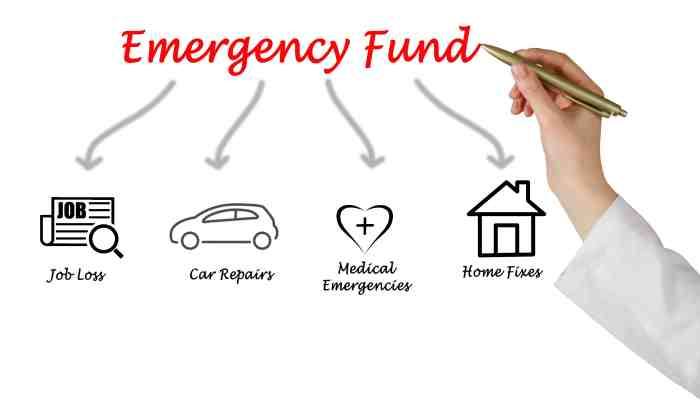
Unexpected life events, from medical emergencies to job loss, can significantly impact our financial stability. Proactive financial planning, specifically building a robust emergency fund, is crucial for navigating these unforeseen circumstances. This guide delves into the practical steps involved in creating and maintaining an emergency fund, empowering you to face financial challenges with confidence and resilience.
We will explore various strategies for determining the appropriate size of your emergency fund, efficient savings methods, and responsible fund management. Understanding the role of an emergency fund within your broader financial strategy is key to achieving long-term financial security and reducing overall financial stress.
Defining Emergency Funds
An emergency fund is a crucial component of a healthy financial plan, acting as a safety net to protect against unforeseen circumstances. It provides a readily accessible source of funds to cover unexpected expenses, preventing you from accumulating debt or disrupting your financial stability. Building a robust emergency fund is a proactive step towards financial security, offering peace of mind during challenging times.An emergency fund’s primary purpose is to provide financial cushioning during unexpected events that require immediate financial attention.
It’s designed to bridge the gap between an unexpected expense and your ability to resolve it without resorting to high-interest debt or disrupting your long-term financial goals. Having this readily available cash can alleviate significant stress and prevent potentially damaging financial decisions made under pressure.
Unexpected Expenses Covered by Emergency Funds
Unexpected expenses that an emergency fund can cover are diverse and can significantly impact personal finances. These range from relatively minor issues to major life events. Examples include unexpected medical bills (like a high deductible or unexpected surgery), car repairs (engine failure, accident damage), home repairs (roof leaks, appliance malfunctions), job loss, or sudden travel expenses (urgent family matters).
Even smaller unexpected expenses like vet bills for a pet or a burst pipe can be easily managed with a sufficient emergency fund.
Emergency Funds versus Other Savings Accounts
While both emergency funds and other savings accounts involve setting aside money, their purposes and accessibility differ significantly. An emergency fund is specifically designed for unexpected and urgent expenses, prioritizing immediate liquidity. This means it’s typically held in a readily accessible account, such as a high-yield savings account or money market account, allowing for quick withdrawals without penalties.
Other savings accounts, such as retirement accounts (401k, IRA) or college funds, have longer-term goals and may have restrictions or penalties associated with early withdrawals. Therefore, they are not suitable for covering immediate emergencies. Investment accounts, while potentially offering higher returns, are also unsuitable due to market volatility and the potential for losses, making them unreliable for emergency situations.
Different Emergency Fund Approaches
The size and structure of an emergency fund can vary depending on individual circumstances and risk tolerance. Some common approaches are Artikeld below:
| Approach | Fund Size | Pros | Cons |
|---|---|---|---|
| 3-6 Months of Living Expenses | Covers basic living expenses for 3-6 months | Provides substantial protection against job loss or prolonged emergencies. | Requires a larger initial investment. |
| Specific Event Funds | Dedicated funds for specific potential emergencies (e.g., car repair fund, medical fund) | Allows for targeted savings and easier budgeting. | May not cover unexpected events outside the designated categories. |
| Hybrid Approach | Combines a core emergency fund with smaller, event-specific funds. | Offers a balance between broad protection and targeted savings. | Requires more complex budgeting and tracking. |
| Minimal Emergency Fund | Covers only 1-2 months of expenses | Easier to achieve for those starting out. | Offers less protection against extended emergencies. |
Assessing Your Financial Situation
Building a robust emergency fund requires a clear understanding of your current financial standing. This involves meticulously tracking your income and expenses to determine how much you can realistically save and how large your emergency fund should be. A well-defined budget is the cornerstone of effective emergency fund planning.
Monthly Expenses and Budgeting
Creating a realistic budget is crucial for assessing your financial health and determining the appropriate size of your emergency fund. This involves listing all your monthly expenses, categorizing them (housing, transportation, food, etc.), and totaling them. You can use budgeting apps, spreadsheets, or even a simple notebook to track your spending. Accurate expense tracking is vital for identifying areas where you might be able to cut back to increase your savings.
For example, analyzing your dining-out expenses might reveal opportunities to reduce spending and allocate more funds towards your emergency fund. Consider using the 50/30/20 rule as a guideline: allocate 50% of your after-tax income to needs, 30% to wants, and 20% to savings and debt repayment.
Income and Expense Tracking Strategies
Several effective strategies exist for monitoring income and expenses. Using budgeting apps automates much of the process by connecting directly to your bank accounts and credit cards, providing a real-time view of your finances. Spreadsheet software allows for detailed categorization and analysis, facilitating better budgeting decisions. Manually tracking expenses in a notebook or journal offers a more hands-on approach, promoting mindful spending habits.
Regardless of the method chosen, consistency is key. Regularly reviewing your income and expenses allows for timely adjustments to your budget and ensures you’re on track to achieve your emergency fund goals. For instance, if unexpected expenses arise, you can adjust your spending in other categories to compensate without compromising your savings goals.
Determining Emergency Fund Size
The ideal size of your emergency fund depends on individual circumstances. A commonly recommended guideline is 3-6 months’ worth of essential living expenses. This ensures sufficient funds to cover unexpected events such as job loss, medical emergencies, or home repairs. For individuals with stable, high-income jobs and readily available credit, a smaller emergency fund might suffice. Conversely, those with less stable income or significant health concerns might benefit from a larger emergency fund, perhaps 6-12 months of expenses.
For example, a freelancer might aim for a larger emergency fund than a salaried employee with employer-sponsored health insurance.
Emergency Fund Needs Calculation Spreadsheet
| Category | Monthly Expense |
|---|---|
| Housing | [Enter Amount] |
| Utilities | [Enter Amount] |
| Transportation | [Enter Amount] |
| Food | [Enter Amount] |
| Healthcare | [Enter Amount] |
| Other Expenses | [Enter Amount] |
| Total Monthly Expenses | [Sum of all expenses] |
To calculate your emergency fund needs, multiply your total monthly expenses by the desired number of months of coverage (e.g., 3, 6, or 12). For example, if your total monthly expenses are $2,000 and you aim for a 6-month emergency fund, you would need $12,000 (2000 x 6).
Emergency Fund Target = Total Monthly Expenses x Number of Months of Coverage
Building Your Emergency Fund
Building an emergency fund is a crucial step towards achieving financial security. It provides a safety net to cover unexpected expenses, preventing you from accumulating debt or disrupting your financial plans. The amount you should aim for is generally 3-6 months’ worth of essential living expenses, but this can vary depending on individual circumstances and risk tolerance. This section will explore various strategies for efficiently building your emergency fund.
Several methods can help you effectively save for emergencies. Understanding the advantages and disadvantages of each option will allow you to choose the best approach for your financial situation. Careful planning and consistent contributions are key to successfully building a substantial emergency fund.
Savings Strategies for Emergency Funds
A multifaceted approach often proves most effective. This could involve a combination of high-yield savings accounts, money market accounts, and potentially even a small portion in easily accessible investments. The allocation will depend on your risk tolerance, access needs, and return expectations.
For instance, a conservative approach might prioritize high-yield savings accounts for their safety and accessibility, while a slightly more aggressive strategy could incorporate a small percentage in a money market account for potentially higher returns. Always remember to prioritize security and liquidity when building an emergency fund.
Examples of High-Yield Savings Accounts and Money Market Accounts
High-yield savings accounts generally offer higher interest rates than traditional savings accounts, allowing your money to grow faster. Examples (note that interest rates are variable and change frequently, so these are illustrative examples only): Some online banks often offer competitive rates, exceeding the national average. For example, a hypothetical online bank, “ExampleBank,” might offer a 4% annual percentage yield (APY) on their high-yield savings account at a given time.
Similarly, money market accounts (MMAs) can offer slightly higher returns but may have slightly higher minimum balance requirements or limited transaction numbers. A hypothetical MMA from “ExampleBank” might offer a 4.5% APY, but might require a $1000 minimum balance. Always check current rates with the financial institution.
Comparison of Savings Vehicles
| Savings Vehicle | Pros | Cons |
|---|---|---|
| High-Yield Savings Account | High interest rates, FDIC insured (up to $250,000 per depositor, per insured bank), easy access | Interest rates can fluctuate, may not offer the highest returns compared to other options |
| Money Market Account | Potentially higher interest rates than savings accounts, check writing capabilities (sometimes), FDIC insured (up to $250,000 per depositor, per insured bank) | May have higher minimum balance requirements, may have limited transaction numbers |
| Certificates of Deposit (CDs) | Higher interest rates than savings accounts, fixed interest rate for a specified term | Money is locked in for a specific period, early withdrawal penalties may apply |
Setting Up Automatic Transfers
Establishing automatic transfers is a highly effective way to consistently contribute to your emergency fund without actively remembering to do so. This method ensures regular contributions and helps you reach your savings goal faster. Many banks and online financial institutions offer this functionality through their online banking platforms.
A step-by-step guide is as follows:
- Log in to your primary bank account online.
- Navigate to the “transfers” or “bill pay” section.
- Select “external account” as the transfer destination.
- Enter your emergency fund account details (account number and routing number).
- Specify the transfer amount and frequency (e.g., weekly, bi-weekly, monthly).
- Review and confirm the transfer setup.
Accessing and Maintaining Your Emergency Fund
Having readily available funds for unexpected events is crucial. The ease of access to your emergency fund directly impacts your ability to handle financial crises effectively and minimize potential long-term consequences. Maintaining the fund requires proactive strategies to prevent depletion for non-emergency purposes and a clear plan for replenishment after use.
Easy Access to Emergency Funds
The primary purpose of an emergency fund is to provide immediate financial relief during unforeseen circumstances. Therefore, accessibility is paramount. Funds should be easily and quickly withdrawn without incurring significant penalties or delays. High-yield savings accounts, money market accounts, or readily accessible portions of investment accounts are suitable options. Avoid locking funds away in long-term investments or assets that require time-consuming liquidation processes, as this defeats the purpose of an emergency fund.
Consider the time it takes to access the money; a delay could worsen a stressful situation.
Preventing Unnecessary Withdrawals
Maintaining a robust emergency fund requires discipline. To avoid depleting it for non-emergencies, create a clear distinction between genuine emergencies and discretionary spending. A detailed budget can help identify areas for cost reduction, allowing you to address financial shortfalls without resorting to the emergency fund. Furthermore, establishing a separate savings account specifically for non-emergency goals (e.g., vacation, home improvement) prevents confusion and accidental misuse of emergency funds.
For instance, setting a separate account for holiday shopping prevents tapping into your emergency fund for gifts.
Replenishing the Emergency Fund
After using your emergency fund, prioritize replenishing it as soon as possible. Treat it like a vital utility bill – a necessary expense. Develop a realistic repayment plan based on your income and budget. Consider increasing your savings contributions temporarily to accelerate the replenishment process. For example, if you withdrew $2,000, aim to save an extra $200-$300 per month until the fund is restored.
The faster you replenish the fund, the quicker you’re prepared for the next unexpected event.
Regular Review and Adjustments
Regularly reviewing and adjusting your emergency fund plan ensures its continued effectiveness.
- Annual Review: At least once a year, assess your current financial situation, emergency fund balance, and the adequacy of the fund given your current expenses and potential risks.
- Life Changes: Significant life events (e.g., marriage, job change, childbirth) necessitate reevaluating your emergency fund needs. Adjust the target amount accordingly.
- Inflation Adjustment: The purchasing power of your emergency fund decreases over time due to inflation. Periodically increase your savings goal to maintain its value.
- Account Performance: Monitor the performance of your emergency fund account. If the interest rate is significantly low, consider switching to a higher-yielding account.
A consistent review process guarantees your emergency fund remains a reliable safety net, adequately protecting you against unforeseen circumstances.
Emergency Fund Planning and Personal Finance
An emergency fund is not merely a savings account; it’s a cornerstone of a robust personal finance strategy. Its presence significantly impacts your ability to navigate unexpected financial challenges and achieve long-term financial goals. A well-structured plan for building and maintaining this fund provides a crucial safety net, allowing for strategic financial decision-making rather than reactive, crisis-driven choices.Emergency fund planning integrates seamlessly with broader personal finance goals.
It’s not an isolated element but a foundational component that supports and protects other financial aspirations. By providing a buffer against unexpected expenses, it reduces the need for high-interest debt and frees up resources for more substantial investments in the future.
The Prevention of Debt Accumulation Through Emergency Funds
An emergency fund acts as a powerful preventative measure against debt accumulation. Imagine facing an unexpected car repair costing $1,000. Without an emergency fund, you might resort to a high-interest credit card, incurring substantial interest charges over time. However, with a well-funded emergency account, you can cover the repair without incurring debt, saving potentially hundreds of dollars in interest payments.
Similarly, a sudden medical bill or job loss can be absorbed without the need for payday loans or high-interest personal loans, thereby preventing a cycle of debt.
The Relationship Between Emergency Funds and Long-Term Financial Goals
A robust emergency fund directly contributes to achieving long-term financial goals. Without the worry of unexpected expenses derailing savings, you can confidently allocate more resources towards investments, retirement planning, or paying off a mortgage. For example, if you have a $10,000 emergency fund, you can confidently invest $5,000 towards your retirement without fear of jeopardizing your financial stability should an emergency arise.
This focused approach significantly accelerates progress toward your long-term objectives.
The Impact of Emergency Funds on Financial Stress and Well-being
The psychological benefits of a well-funded emergency fund are substantial. Knowing you have a financial safety net significantly reduces stress and anxiety related to unexpected events. This improved financial security translates into better overall well-being. Consider the peace of mind experienced by a family with a substantial emergency fund during a period of unemployment. The absence of financial pressure allows them to focus on job searching and other aspects of their lives, rather than being consumed by immediate financial worries.
This reduces stress levels, improves mental health, and contributes to a higher quality of life.
Illustrating Emergency Fund Scenarios
Understanding the practical implications of having or lacking an emergency fund is crucial for effective financial planning. Real-life scenarios vividly demonstrate the significant impact an emergency fund can have on navigating unexpected financial challenges.The following scenarios highlight the stark contrast between a financially secure situation and one fraught with hardship due to the absence of adequate savings.
Emergency Fund Prevents Significant Financial Hardship
Imagine Sarah, a single mother working as a teacher. She diligently saved three months’ worth of living expenses in an emergency fund. Unexpectedly, her car, essential for commuting to work and transporting her child, breaks down requiring a significant repair bill of $2,500. Without missing a beat, Sarah accesses her emergency fund, covers the repair, maintains her stable income, and avoids the stress and potential debt associated with borrowing money or delaying the repair.
Her children’s schooling and daily needs remain unaffected. This scenario demonstrates how a well-planned emergency fund can act as a safety net, absorbing unexpected expenses without disrupting daily life or incurring debt.
Lack of Emergency Fund Leads to Negative Consequences
Consider Mark, a freelance graphic designer. He experienced a sudden, unexpected illness requiring extensive medical treatment. Lacking an emergency fund, Mark faced mounting medical bills, forcing him to take on high-interest credit card debt to cover the costs. The financial strain impacted his ability to focus on work, resulting in missed deadlines and a loss of income.
His credit score suffered, making it difficult to obtain loans or even rent an apartment in the future. This situation exemplifies how the absence of an emergency fund can lead to a domino effect of negative consequences, snowballing into long-term financial difficulties.
Comparison of Financial Outcomes
Let’s visualize the financial outcomes with a simple table:| Scenario | Emergency Fund | Income Stability | Debt | Credit Score | Stress Level ||———————–|—————–|——————–|——-|————–|—————|| Sarah (with fund) | Yes | Maintained | None | Unaffected | Low || Mark (without fund) | No | Significantly impacted | High | Damaged | High |This table clearly illustrates the protective nature of an emergency fund.
Sarah’s proactive planning resulted in financial stability and peace of mind, while Mark’s lack of preparation led to a cascade of negative financial and emotional consequences. The contrast underscores the importance of establishing and maintaining an emergency fund as a cornerstone of sound personal finance.
Establishing and maintaining an emergency fund is not merely a financial practice; it’s a cornerstone of financial wellness. By proactively planning for the unexpected, you safeguard your financial future, reducing stress and building resilience against life’s inevitable curveballs. This comprehensive guide has equipped you with the knowledge and tools to build a robust emergency fund, providing a crucial safety net for you and your family.
Clarifying Questions
How long should I aim to save for my emergency fund?
The general recommendation is 3-6 months’ worth of living expenses, but this can vary based on individual circumstances and risk tolerance.
Where is the best place to keep my emergency fund?
High-yield savings accounts or money market accounts offer accessibility and a competitive interest rate. Avoid investments that carry higher risk and lower liquidity.
What if I have an emergency before my fund is fully built?
Prioritize essential expenses and consider borrowing from family or friends, or explore low-interest loans as a last resort. Resume building your emergency fund as soon as possible.
Should I include debt repayment in my emergency fund calculations?
While ideally you should tackle debt aggressively, it’s best to focus your emergency fund on covering essential living expenses. Debt repayment can be a separate financial goal.


